


Prof. Dr Bart Van de Vijver
|
Research scientist: Phycology |
 |
Diatom biodiversity, biogeography, taxonomy and environmental assessment
My research focuses on diatoms, unicellullar eukaryotic algae characterised by a siliceous outer shell. The research is focused on their biodiversity, taxonomy, ecology and biogeography, with particular emphasis on poorly known environments, difficult species complexes and the relationship between taxonomic diversity and environmental conditions.
In my work I combine field research with microscopy, the study of historical collections, species-group revisions and ecological assessment. Alongside fundamental taxonomic research, I have extensive experience in diatom-based water-quality monitoring and in bringing taxonomic expertise together through international workshops and European intercalibration exercises.
My scientific activities can be grouped into four main closely connected areas. Polar field research reveals new patterns of diversity and biogeography. Species-group revisions and historical collections provide the taxonomic framework needed to recognise that diversity. Water-quality biomonitoring translates detailed taxonomic knowledge into environmental information. Workshops, intercalibration exercises and academic supervision help ensure that this knowledge is shared and applied consistently across Europe, contributing to the development of the wider research community.
Biogeographical and ecological research in polar regions
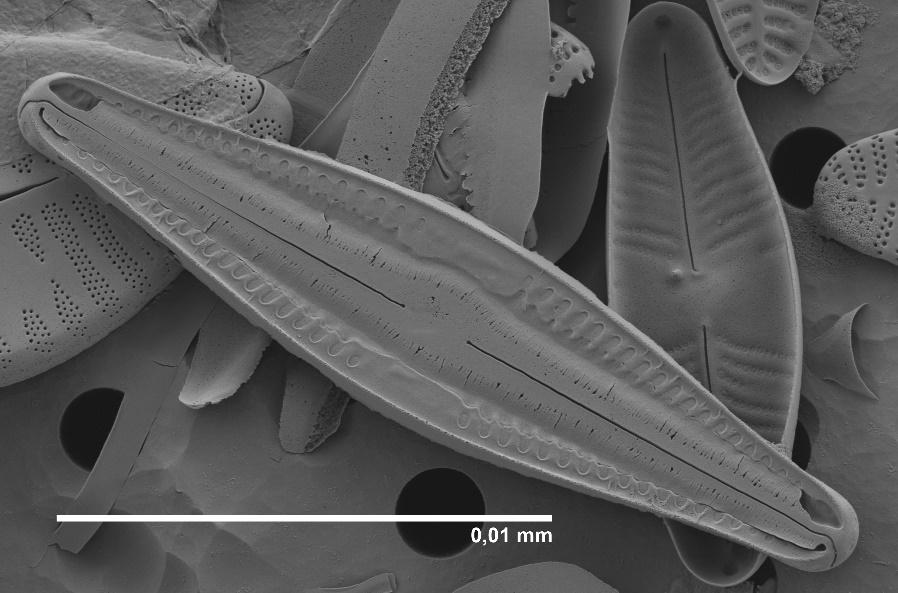 Polar and subpolar environments are a major focus of my research. These regions offer exceptional opportunities to study the distribution, ecological preferences and evolution of diatoms in environments that are often geographically isolated and relatively poorly investigated.
My research has covered freshwater and terrestrial habitats in the Maritime Antarctic, sub-Antarctic and Arctic regions, including the South Shetland Islands, James Ross Island, and the islands in the southern Indian and Atlantic Ocean (Iles Crozet, Iles Kerguelen, …) and Arctic localities such as Greenland, Svalbard and northwestern Iceland. Polar freshwater systems range from streams, lakes and temporary pools to springs, wet soils and mosses. Mosses are especially interesting because they provide humid microhabitats in otherwise harsh environments and can harbour surprisingly diverse diatom communities.
Recent research has shown that polar diatom floras are considerably more diverse and geographically structured than traditionally assumed. Until recently, due to misidentifications and force-fitting, the actual number of described species was thought to be rather limited and composed of only cosmopolitan species, resulting in a bad knowledge of their biogeographical distribution. New results revealed the presence of a unique diatom flora composed of a large number of (newly described) endemic species, contradicting all previous biogeographical hypotheses. The research also contributes to broader questions concerning endemism, dispersal, biogeographical patterns and the response of microbial communities to environmental gradients.
Biodiversity research in Europe: revising species groups using modern and historical collections
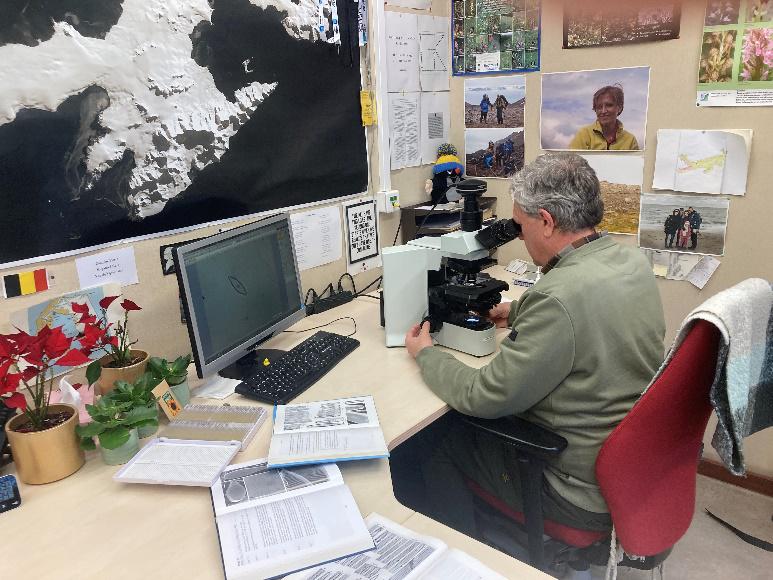 A second major component of my research is the analysis of the morphology and taxonomy of freshwater diatom biodiversity in Europe. Many European diatoms were described during the nineteenth and early twentieth centuries. At that time, species were often recognised based on relatively limited morphological information. Subsequent authors sometimes combined several taxa under a single name, resulting in broadly defined species that were later considered to have very large geographical ranges.
Detailed examination of recent material using light microscopy and scanning electron microscopy frequently reveals that these apparently widespread species actually comprise several distinct taxa. Revising such species groups can therefore substantially change our understanding of European biodiversity.
An essential part of this work is the integration of recent collections with historical material. Meise Botanic Garden conserves the important Henri Van Heurck diatom collection, one of the most significant historical diatom collections in the world, containing hundreds of type materials and other historically significant samples. Revisiting these specimens, together with the original publications and illustrations, allows historical names to be connected with modern taxonomic concepts. The combination of historical collections and newly collected material is especially valuable because it makes it possible to ask not only what species occur today, but also how our perception of their diversity and distribution has changed over time.
This approach has resulted in important revisions in genera such as Nitzschia, Fragilaria, Staurosira, Staurosirella, Pseudostaurosira, Brachysira, Achnanthidium and Planothidium.
Expertise in diatom-based water-quality biomonitoring
Diatoms are among the most widely used biological indicators for assessing the ecological condition of rivers and other surface waters. Their community composition responds to environmental factors including nutrient availability, pH, conductivity, and salinity.
I have extensive expertise in diatom analysis and water-quality biomonitoring, covering the complete analytical process from sample preparation and microscopic identification to counting, taxonomic quality control and ecological interpretation. This expertise is made available as a (payable) service to external stakeholders such as private companies, government agencies or institutes, wishing to get an analysis of the water quality based on diatoms.
Taxonomic workshops, European intercalibration exercises and academic supervision
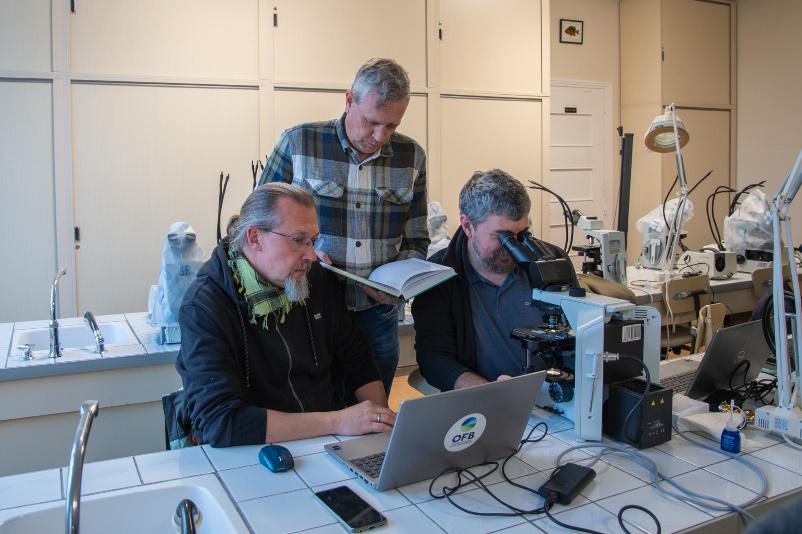 Sharing taxonomic expertise with colleagues and students, is an important part of my scientific activities. Since 2010, highly detailed taxonomic workshops are organised in four languages (Dutch, French, English and German) for diatom analysts and researchers, with participants from different European countries. These workshops focus particularly on difficult, recently revised or taxonomically unstable groups, combining presentations on taxonomy and morphology with practical examination of diatom samples under the microscope. Topics have included genera and species complexes such as Achnanthidium, Planothidium, Nitzschia, Navicula, Fragilaria, Staurosira, Staurosirella, Pseudostaurosira and Brachysira.
I also participated in several European intercalibration and intercomparison exercises involving diatom analysis. Such exercises are essential for ensuring that laboratories in different countries apply comparable taxonomic and analytical approaches. By examining the same material, comparing identifications and discussing discrepancies between analysts, these exercises help identify problematic taxa and improve consistency in ecological assessment.
Training the next generation of researchers is another important part of my academic activities, (co-)supervising Master's and PhD research projects dealing with diatom taxonomy, biodiversity, ecology, biogeography and environmental assessment. These projects can involve field sampling, microscopic analysis, species identification, taxonomic revision, ecological data analysis and the study of historical collections. Supervision provides an opportunity to introduce young researchers to the combination of approaches that is increasingly important in modern diatom research: careful morphological observation, critical use of historical literature and collections, ecological interpretation and, where appropriate, modern analytical techniques.
Qualifications
Degrees
- PhD (Biology), University of Antwerp, Belgium (1999)
- Licentiate/MSc (Biology), University of Antwerp, Belgium (1995)
Employment history
- Assistant Professor, Biology Department, University of Antwerp, Belgium (2012-ongoing)
- Senior researcher, Meise Botanic Garden (2006-ongoing)
- Postdoctoral researcher, Fund for Scientific Research, Flanders, University of Antwerp (1999-2006)
- Research Assistant, Fund for Scientific Research, Flanders, University of Antwerp (1995-1999)
Professional activities
- President of the International Society for Diatom Research (ISDR) (2026-ongoing)
- President of the Association des Diatomistes de langue Française (ADLaF) (2014-2024)
- President of the Nederlands-Vlaamse Kring van Diatomisten (NBKD) (2001-2011, 2015-2019)
- Secretary of the Studiegroep Europese en Mediterrane Orchideeën (S.E.M.O. vzw) (2019-ongoing)
- Associate editor for Nova Hedwigia, Notulae Algarum, Fottea, Plant Ecology & Evolution
- Associate member of the Academy of Overseas Sciences
- Editor of Iconographia Diatomologica
- Editor of Bibliotheca Diatomologica


